
Jazz for the Revolution
Acknowledgements
Built around the timeless musical compositions of Johnny Dyani: 30.11.45 – 24.10.86: Jazz Against Apartheid is a complete archive of 30 years of exile history. The musical collaboration around the work of Dyani continue to inspire. Jazz Against Apartheid is a complete archive of 30 years of exile history. The musical collaboration around the work of Dyani continue to inspire. It is a profound cross-fertilization and is developed on a foundation of 30 years of exile history from friendships born and united in South Africa's struggle for freedom.Dyani’s compositions show the merging of folk music and jazz music. He took the functionality of folk music and combined it with the freedom of jazz, to build a community abroad that fought the struggle against Apartheid and won. His compositions bridged music and society, and his harmonic approach had the effect of bringing solidarity and change to the social disharmony. It is a timeless approach. Dyani’s wife Magdalena confirmed his deep sense of African music: “He loved African folksongs religious music and church choirs. He sang in Xhosa, chanted and danced on stage. He was aiming to develop a creative interest beyond tribal stereotypes.”
Dyani performed this music throughout the seventies and eighties with a diverse group of musicians from South Africa, America, Turkey, North Africa, Caribbean, UK, Sweden and France. Through far reaching musical collaborations in exile, he was a forerunner of unity through diversity, or uBuntu as we have come to know it in South Africa.
As he said, “I’ve had interracial bands because I believe in the unity of the universe.”
And as a result his music crossed over into multiple genres: “I am a folk musician,” said Dyani, “and I don’t like to see my work described as jazz because it introduces connotations that I don’t regard as relevant.”
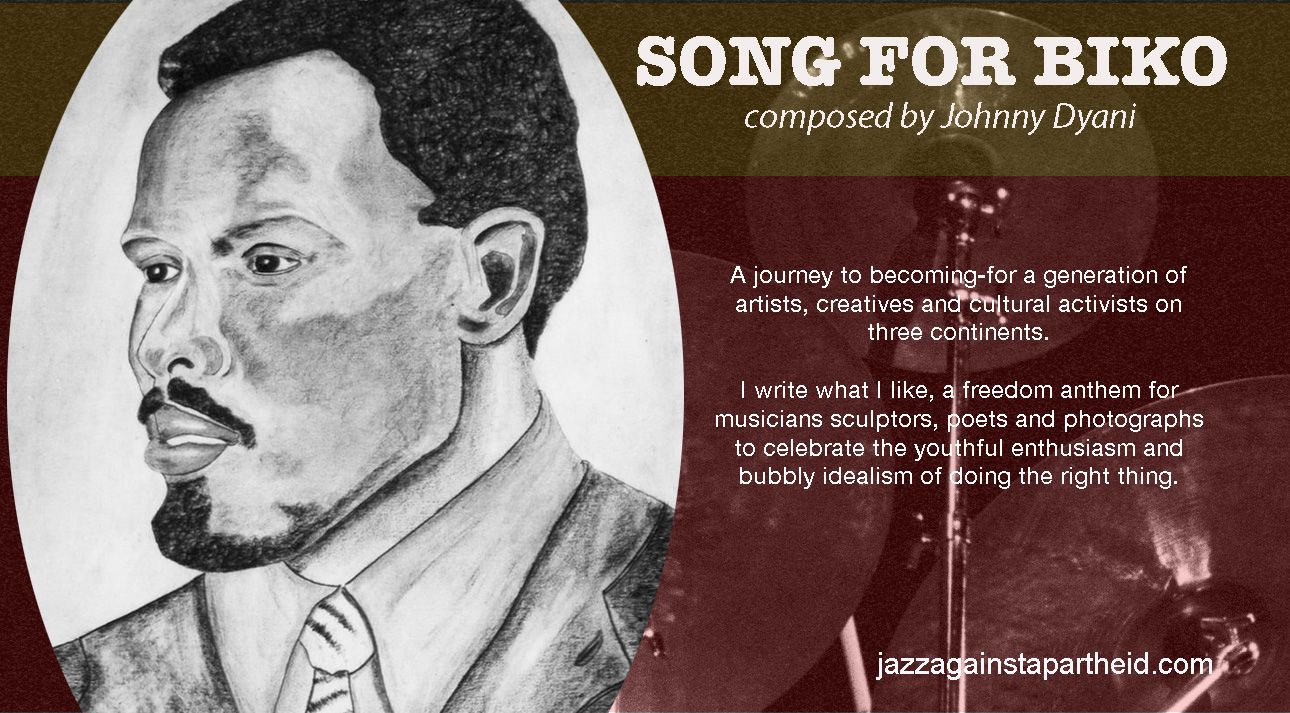
Through the audio-visual documentation of skills transfer or Nachwuchsförderung, the eclectic compositions of Johnny Dyani are revived, learnt and performed. These are the same compositions that carried the flame of South Africa’s liberation worldwide through his ground breaking album Song for Biko and the movement he inspired, Jazz Against Apartheid."I did it for my country, for my people," Johnny Dyani
The story traces his career through his formative years were as an acapella singer, a pianist, bassist at home in Duncan Village (1945 – 1962). Revelling in the vocal groups of Duncan Village, the journey passes through the young giants of Eastern Cape Jazz (Feza, Pukwana), a bass mentorship with the Jazz Wizards and a baptism into free jazz with the legends of Port Elisabeth, Cape Town and Dorkay House, before as a 17-year-old joined South Africa’s first mixed band – the Blue Notes and heading overseas never to return.
The story traces the emotion of dislocation of suppression. Dyani carried the soil of his home with him both in his pocket and in his musical compositions. The international jazz movement and breakaway collaborations of the South African musicians transformed musical expression into the free-jazz movement in Europe.
Dyani became the foremost composer and collaborator on the European jazz scene. But as the head of the ANC cultural wing in exile and out of the various anti-aparhied movements including Artists Against Apartheid in Sweden he founded the Jazz Against Apartheid movement in 1986.
With the support of fellow musicians, unsung heroes living and late the micro-film project is an episode in the long-standing commitment to continuing Dyanis work and growing the link between Eastern Cape Jazz and the movement to progressive European musicians.
